
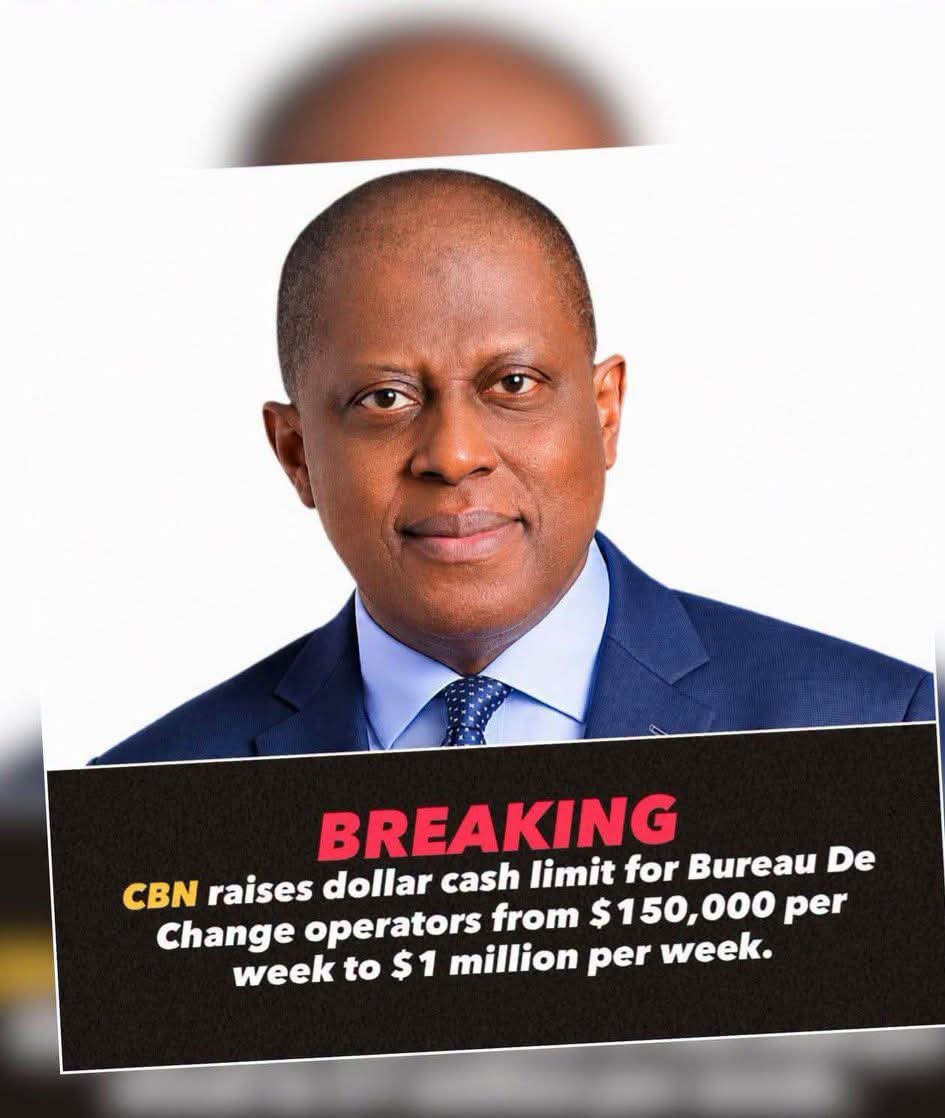
- The CBN has temporarily raised the weekly dollar limit for Bureau De Change operators from $150,000 to $1 million — and the full amount can now be taken in cash.
- The old $150,000 limit stood all year while the naira suffered. The change came on November 25, less than 12 weeks before the presidential election on February 20, 2027.
- Elections in Nigeria run on dollars. Politicians need hard cash to pay agents, buy loyalty, and bribe voters — and the CBN has just made cash dollars easier to get.
- The CBN says it is about “seasonal demand.” The timing says otherwise. What do you think?
The CBN has suddenly opened the dollar taps wide. Let us call the timing what it is.
What happened
On Tuesday, November 24, the Central Bank of Nigeria emailed the banks with a big change: from Wednesday, November 25, licensed Bureau De Change operators can buy up to $1 million a week — and take the whole amount in physical dollar cash.
Under the old rule, in place since February 2026, a BDC could buy $150,000 a week, and only a quarter of it — $37,500 — could be collected as cash. Now the cash ceiling is $1 million. That is more than 26 times what a BDC could hold in notes before.
No public circular. No end date. Just an email to the banks, and suddenly the taps are open.
Let us be honest about the timing
The CBN says this is about “seasonal demand pressures” and making dollars easier for ordinary Nigerians to get. Fine. But let us ask the simple question: where was this help all year?
The naira was under pressure in January. It was under pressure in June. It was under pressure in October. Ordinary Nigerians were struggling to find dollars for school fees, for travel, for small businesses — and the limit stayed at $150,000. Year-end demand comes every single year. Nothing about December 2026 is new.
What is new is the calendar. The presidential election is February 20, 2027. Campaigns are already moving. And everybody knows how elections work in Nigeria: politicians depend heavily on dollars. Hard cash pays the agents, moves the crowds, buys the loyalty, and bribes the voters. A politician with naira is limited. A politician with dollar cash can do anything.
So the CBN had to increase the amount now — because the people who need dollars the most right now are not travellers and small traders. It is the politicians, and they need it in cash. Cash leaves no trail. A bank transfer can be traced. A bag of dollar notes cannot.
That is why this is cash, not transfer. That is why it is now, and not in March, when the naira was also falling. And that is why there is no end date on the measure — because the election is the end date.
Who really benefits?
Let us also ask who can actually buy $1 million a week from a BDC. Not the mother paying her child’s school fees. Not the small trader importing goods. The ordinary Nigerian still buys a few hundred dollars at a time — if they can find it. The people who move in millions are the big men, the politicians, and their agents. This policy opens the door wide for them, and the rest of us are told it is for our own good.
Meanwhile the parallel market rate barely moved — still around ₦1,450 to the dollar. So if this was about helping ordinary Nigerians, where is the help? The naira firmed a little in the official market, but on the street, where most Nigerians actually buy dollars, nothing changed.
So, what do you think?
We are not saying the CBN sat down and planned this for the election. What we are saying is that the timing stinks, and Nigerians are not fools. A 26-fold jump in cash dollars, done quietly by email, with no end date, weeks before an election where dollars buy votes — you do the maths.
Is this the CBN fixing a real dollar shortage at Christmas time? Or is it election-season dollars, dressed up as seasonal demand? Or both?
Tell us in the comments. And if you buy dollars from a BDC, or you work in forex or banking, tell us what you are seeing on the ground. We want to hear it from real people, not from press statements.
Sources: Techpoint Africa; Vanguard; Nairametrics via QNC News; News Nexus; INEC 2027 election timetable (presidential election February 20, 2027).



Leave a Reply